
Abstract
Background: Coronavirus has rapidly spread worldwide for several months. Ukraine, like many other countries, was affected by a pandemic. As in most countries of the world, due to the rapid spread of coronavirus infection, Ukraine has established a quarantine at the state level, which restricts the movement of citizens and appeal for staying at home.
COVID-19 has affected many aspects of life in the country. The unpreparedness of Ukrainian medicine, people's fatigue from everyday problems and other aspects - all these factors are also affected the mental health of the Ukrainians during a pandemic. We tried to find out how being quarantined through COVID-19 affected the emotional and hedonic background of Ukrainians living in the capital of Ukraine, the city of Kyiv and adjacent Kyiv region.
Materials and methods: The study was conducted during 62 days of officially announced quarantine due to COVID-19: from March 12 to May 11, 2020 inclusive. The study voluntarily involved 68 residents of Kyiv and Kyiv region who did not have mental disorders at the time of the interview. We used the Anhedonia Scale (Snight-Hamilton Pleasure Scale, SHPS) and the scale for assessing psychological health and quality of life (General Well-Being scale, GWBS). Interviews with respondents during quarantine were conducted using modern telecommunications technologies (e.g, Skype, Zoom, contacts via social networks, etc.). But there were also regular interviews with answerers if they needed psychological help.
Results and conclusions: The study revealed the presence of anhedonia in one third of respondents, which turned out to be about 10 percent more than among respondents without distress. It was found that anhedonia was observed more often in women than in men. These data are different from those obtained in the survey in a normal situation. The anhedonia of social contacts and interactions was most noticeable. The survey also noted expressed anxiety, tension, and fear for the own health of respondents, their loved ones, and relatives as well.
Background
Ukraine is one of the developing post-Soviet countries in the center of Eastern Europe. Coronavirus disease has affected many sides of the country's life. The unreadiness of Ukrainian medicine, people's fatigue from everyday problems aimed at surviving under states of economic development, and other aspects - all these factors are affected the mental health of the country's inhabitants in a pandemic. We tried to find out how the quarantine events touched the emotional and hedonic level of the Ukrainians living in the capital of Ukraine the city of Kiev and the adjacent its Kiev region.
Introduction
The first case of coronavirus SARS-CoV-2 was confirmed in Ukraine in Chernivtsi region on March 3rd, 2020 when the first person was hospitalized with symptoms of infection. Then, the 2019–20 coronavirus pandemic was confirmed to have spread to Ukraine [1]. Since March 12, the government has been established the quarantine throughout the Ukraine [ 2;3].
The spread of COVID-19 to the city of Kyiv was noted on March 16, 2020. [4], and the next day, March 17, 2020, to the Kyiv region [5]. In response to the spread of the 2019–20 coronavirus pandemic in Ukraine, on March 20th, the emergency was determined in majority of regions including city of Kiev and Kiev region [6].
Under quarantine, the public transport as ground and underground as well was suspended [2;7]. Intercity trains were discontinued either [2]. Movement through the city and out became possible only by private cars. As in other regions of Ukraine, in the city of Kiev and Kiev region there were lack of face masks and hand sanitizers in pharmacies.
In the face of increasing information pressure from the media, food was bought up, prices for basic needs (e.g. face masks, disinfectants, food, and housing bills) were inflated, the salary was reduced. For quarantine violation was introduced administrative and even criminal liability [2, 8]. Under these conditions, people became more anxious, more complained on fears and the uncertainty of the future.
Officially, from March 12th to May 11th, 2020, in the city of Kiev were recorded 1960 cases of illness and 40 deaths, and in the Kiev region 1049 cases and 24 deaths respectively [9]. Quarantine state, lack of confidence in the future, the media reports about the unpreparedness of Ukrainian medicine - all these factors are amplified pressure and caused concern of Ukrainians. The questions “what will happen to the job?”, “How do we survive this?”, “How long will this last?” and other were increasingly asked by people.
We decided to conduct a study of the hedonic and emotional state of people under quarantine - during event that restrict people movement and engage them to stay home in closed spaces by the government rules.
Materials and methods
The study was conducted within 62 days of officially declared quarantine from March 12 - May 11, 2020, until the introduction of the 1st phase of businesses reopening due to COVID-19. The survey included respondents living in the city of Kiev and Kiev region.
Respondents voluntarily agreed to participate in the study, both by writing and by word of mouth.
The survey involved 68 people. 26 men and 42 women agreed to the study. The age of the respondents ranged from 20 to 74 years (average 47.6 years).
We used the anhedonia scale (Snight-Hamilton Pleasure Scale, SHPS), which determines the level of anhedonia (lack of pleasure) in a certain period of time and the scale for assessing psychological health and quality of life (General Well-Being Scale, GWB Scale), which allows to measure the quality of life over the past month.
The interviews with respondents under quarantine was carried out using modern telecommunication technologies (e.g. Skype, Zoom, contacts via social networks, etc.). We asked privately our friends, relatives, colleagues and their friends, relatives, etc., and colleagues as well who are living in the city of Kiev and Kiev region to answer two questionnaires by telecommunication methods named above. But there were also private classic interviews when seeking psychological help.
The study was conducted in Kiev medical institute of Ukrainian Association of Folk medicine with the close aid of colleagues from TMA "Psychiatry" in the city of Kiev.
Results
While quarantine we interviewed 68 respondents with no signs of mental disorders at the time of the conversation. Respondents had no problems understanding the questionnaires and did not need further clarification of them.
During the survey 66.1% of all respondents noted a state of anxiety and unrest, 73.5% of them declared tension, and 63% of all answerers often feared for their own health.
The study showed the following distribution among respondents: 47 people (69.12%) - did not have anhedonia (40 or more points on SHPS) and 21 people (30,88%) had anhedonia in a particular area (39 points and less on SHPS).
Among the respondents with anhedonia there were 8 men (38%), and 13 women (62%). The age of the anhedonic answerers ranged from 35 to 66 years (the average age was 48.4 years). 42.8% had mild anhedonia (4 men and 5 women), 57.1% observed a moderate anhedonia - 4 men and 8 women. Severe anhedonia was not observed in any of the respondents.
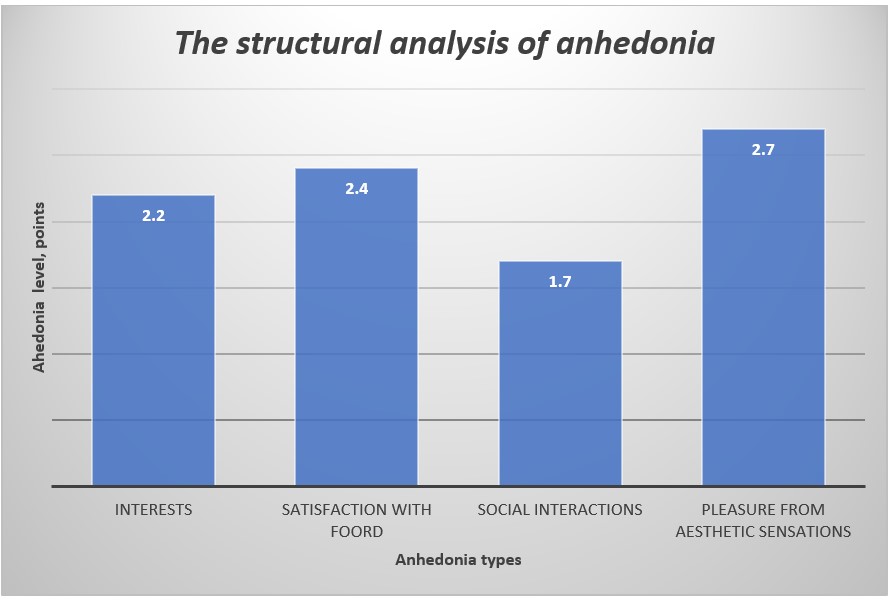
Within the structural analysis of anhedonia, it was revealed (Fig. 1) that the most often respondents did not enjoy social interaction (1.7 out of 4 points). The second most important point was anhedonia of interests (2.2 points out of 4). Satisfaction with food (2.4 points out of 4) and pleasure from aesthetic sensations (2.7 points out of 4) were less significant.
Figure 1. The structural analysis of anhedonia
Thus, the study revealed the presence of anhedonia among the respondents and its pattern was analyzed.
An analysis of the psychological health by GWB Scale in anhedonic respondents over the past month (Fig. 2) revealed increased “nervousness” in19 people (90%); a sense of hopelessness, unrest in 19 people (90%); a feeling of depression - 17 people (80.9%); 19 people (90%) felt anxiety; 17 people (80.9%) ”felt empty’’; 20 people (95.2%) had been stressed; 14 people (66.6%) had lack of energy; 16 people (76.2%) were often worried about their own health. (fig.2 about here)
In addition, 85.7% (18 people) of answerers with anhedonia rated their quality of life by GWBScale as satisfactory, and 14.3% (3 people) as good.
Figure 2. Analysis of the psychological health by GWB Scale in anhedonic respondents over the last month
Discussion
The results of previous studies found that the level of anhedonia in healthy respondents who were in normal conditions without distress was 21% [10]. At that date, anhedonia was observed in 46.2% of women and 53.8% of men. Amongst them predominated the anhedonias of social interactions and satisfaction with food (2.5 points out of 4 in each by SHPS), then went the anhedonia of pleasure from aesthetic sensations (2.6 points out of 4 by SHPS) and the last, anhedonia of interests (3.4 points out of 4 by SHPS).
Other researchers [11; 12] have confirmed the presence of anxiety and fears, including for their own health and for the health of loved ones. Our study noted a high level of anxiety, feelings of tension and concern for their health as well.
During the interviews, it was also interesting that the owning the vehicles by the respondents contributed to a decrease in the level of anhedonia or even its absence. People said: “we can go outdoor and go away from the city, and not being in apartment all the time”, “it somehow saves our mood, because it’s difficult to be indoors entire family all the time”, “tired to look at the sky only from my window or a porch/balcony”.
Conclusions
- An analysis of the results in out short survey determined that respondents who were under quarantine had the anhedonia in 30, 8% of cases, which is about 10% more than among answerers without distress.
- The current study found that women had anhedonia more often than men 1.6 times, which differs from the data obtained for respondents under ordinary situation.
- It was noted, that along with respondents without distress the subjects in our study showed the most pronounced lack of pleasure from social contacts and interactions. This gives us the opportunity to consider that the social communication is the most vulnerable element when the emotional state in disturbance.
- Along with anhedonia, have been identified a high level of tension and anxiety, and concern for own health as well.
References
- KyivPost. First coronavirus case identified in Ukraine. Kyiv: KyivPost; 2020. URL: https://www.kyivpost.com/ukraine-politics/developing-first-coronavirus-case-identified-in-ukraine.html
- RBC Ukraine. Quarantine in Ukraine due to coronavirus is introduced on March 12 (ru). Kyiv: RBC Ukraine; 2020. URL: https://www.rbc.ua/rus/news/ukraine-vveli-karantin-koronavirusa-1583919251.html
- Cabinet of Ministers of Ukraine. On prevention of the spread of acute respiratory disease COVID-19 caused by coronavirus SARS-CoV-2 on the territory of Ukraine. Kyiv: CMU; 2020. URL: https://zakon.rada.gov.ua/laws/show/211-2020-%D0%BF
- Ukrainska Pravda. Coronavirus reached Kyiv: 2 cases at once. Kyiv: Ukrainska Pravda; 2020. URL: https://www.pravda.com.ua/news/2020/03/16/7243873/
- Ukrainian Pravda. 4 people "found" coronavirus on the territory of Ukraine - chief sanitary doctor. Kyiv: Ukrainska Pravda; 2020. URL: https://www.pravda.com.ua/news/2020/03/17/7243904/
- TSN. An emergency has been declared in another region of Ukraine because of the Coronavirus. Kyiv: TSN; 2020. URL: https://tsn.ua/ru/ukrayina/v-esche-odnoy-oblasti-ukrainy-obyavili-chrezvychaynoe-polozhenie-iz-za-koronavirusa-1511883.html
- RBC Ukraine. Transport quarantined: how Ukraine will live from today. Kyiv: RBC-Ukraine; 2020. URL: https://www.rbc.ua/rus/news/transport-ushel-karantin-ukraina-budet-zhit-1584473793.html
- RBC Ukraine. A fine of UAH 17,000 and criminal liability: how to punish for quarantine in Kyiv. Kyiv: RBC-Ukraine; 2020. URL: https://www.rbc.ua/rus/news/shtraf-17-tys-grn-ugolovnaya-otvetstvennost-1585646956.html
- Ministry of health of Ukraine. COVID-19 pandemic in Ukraine. Kyiv: MHU; 2020. URL: https://covid19.gov.ua/analitichni-paneli-dashbordy
- Orlova N. Anhedonia at psychiatry in-patients with endogenous disease. Archives of psychiatry. 2008;3(54):36-8. URL: https://www.researchgate.net/publication/341471196_Anhedonia_at_psychiatry_in-patients_with_endogenous_disease
- Dai Y, Hu G, Xiong H, Qiu H, Yuan X. Psychological impact of the coronavirus disease 2019 (COVID-19) outbreak on healthcare workers in China. MedRxiv. 2020;3(3). DOI: https://doi.org/10.1101/2020.03.03.20030874 URL:https://www.medrxiv.org/content/10.1101/2020.03.03.20030874v1
- Wang C, Pan R, Wan X, et al. Immediate Psychological Responses and Associated Factors during the Initial Stage of the 2019 Coronavirus Disease (COVID-19) Epidemic among the General Population in China. Int J Environ Res Public Health. 2020;17(5):1729. DOI: https://doi.org/10.3390/ijerph17051729 PMID: https://pubmed.ncbi.nlm.nih.gov/32155789/